// blog/claude-constitution-how-it-works
Claude Constitution: How It Works

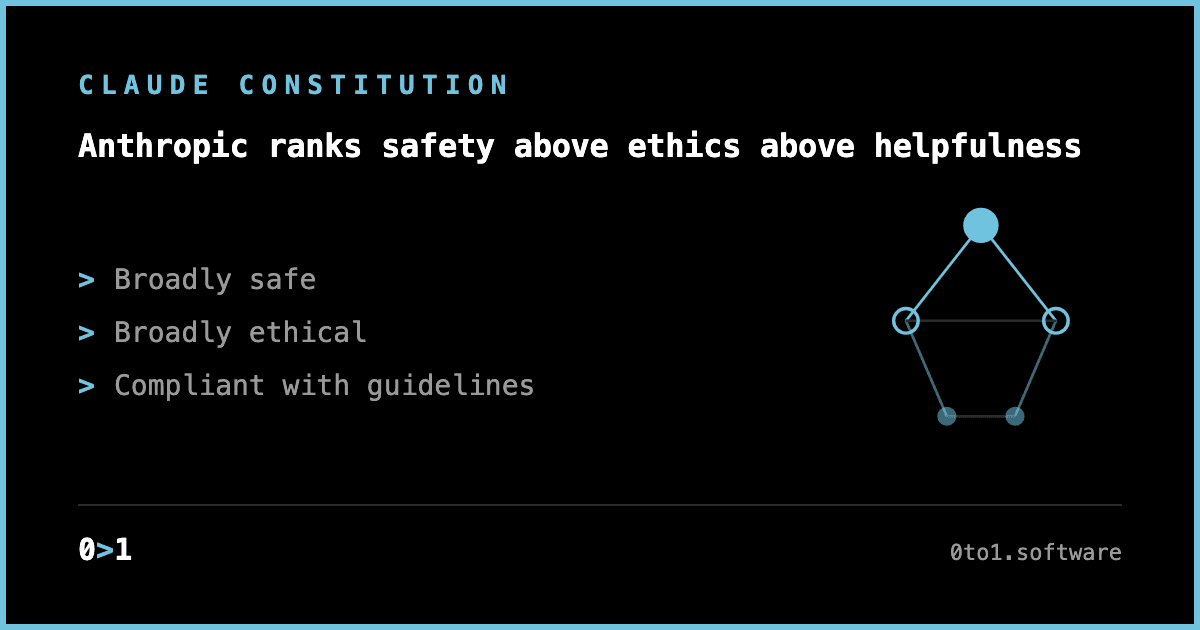
Anthropic has published a new Constitution for Claude: a public document that describes the values and behavior it wants Claude to embody, and that directly participates in training future models. The important change is architectural as much as editorial. Anthropic has moved from a list of standalone principles toward a long-form explanation of intent, priorities, tradeoffs, and model context. The document is released under CC0 1.0, so anyone can read, reuse, or critique it.
What is Claude’s Constitution?
Claude’s Constitution is Anthropic’s final authority for the intended behavior of its mainline, general-access Claude models. Other training or instructions should be consistent with both its wording and underlying purpose.
Anthropic describes the Constitution as an input to multiple stages of model training rather than a system prompt pasted in front of every conversation. Claude also uses it to generate synthetic training material: explanations of the Constitution, conversations where it is relevant, candidate responses aligned with its values, and rankings between possible responses. Those artifacts can then train later versions of Claude.
This makes the document more consequential than a public policy page. It is intended to affect the data that shapes model behavior.
The document has two audiences:
- Claude, which Anthropic says is its primary audience
- People trying to understand what behavior Anthropic intends, versus behavior that emerges despite that intention
That second audience matters because models can fail in ways that look deliberate from the outside. A public Constitution gives users and researchers a reference point. If Claude’s behavior conflicts with a stated priority, the disagreement is concrete rather than a dispute over an unpublished internal preference.
How does Claude’s Constitution affect training?
Anthropic says Constitutional AI has been part of Claude training since 2023. The new approach gives the Constitution a more central role, especially in producing synthetic data used for future training.
A simplified version of the process looks like this:
Constitution
   |
   +--> Claude generates examples, explanations, and response rankings
   |
   +--> Training data reflecting intended values
   |
   +--> Future Claude models trained on that data
   |
   +--> Evaluation against the intended behavior
The key technical claim is that a model needs more than isolated behavioral commands if it is expected to handle unfamiliar cases. A rule can identify a prohibited action, but it is less useful when the model must reason about a conflict between honesty, privacy, helpfulness, a platform instruction, and potential harm.
Anthropic’s example is a rule requiring a model to recommend professional help whenever an emotional topic arises. Such a rule may be well intentioned, yet it can produce inappropriate or rigid responses. The new Constitution tries to supply the reason for a behavior so the model can generalize beyond the examples used in training.
That is a real tradeoff: rules are easier to test, but a long explanation creates more room for contextual judgment, and more room for a model to misunderstand the judgment being requested. Anthropic retains explicit “hard constraints” for especially high-stakes conduct where Claude should never participate.
What are Claude’s priorities?
The Constitution gives Claude four ordered priorities. In an apparent conflict, Anthropic says Claude should generally follow this sequence:
| Priority | Intended meaning |
|---|---|
| Broadly safe | Preserve appropriate human ability to oversee and correct AI behavior |
| Broadly ethical | Act honestly, avoid harmful or inappropriate conduct, and apply good values |
| Compliant with Anthropic’s guidelines | Follow more specific instructions where they apply |
| Genuinely helpful | Benefit the operators and end users interacting with Claude |
Anthropic places broad safety above ethics during the current period of AI development. Its stated reason is practical: current models can make mistakes because of flawed values, mistaken beliefs, or limited context. Human operators therefore need the ability to monitor, intervene, and prevent actions.
This is a narrow claim about uncertainty in the model and the need to keep correction mechanisms available while those uncertainties remain, rather than an argument that oversight is morally superior to ethics.
The Constitution also frames helpfulness as substantive help rather than polished compliance. Anthropic describes the desired assistant as frank, caring, and willing to treat users as adults capable of making decisions. At the same time, helpfulness is constrained by the higher priorities and by more specific guidelines when Anthropic has relevant information that the model lacks.
Why does the Constitution discuss multiple principals?
A deployed model does not serve one party. Anthropic identifies three relevant principals:
- Anthropic itself
- Operators building on the API
- End users
That distinction becomes important as soon as instructions conflict. An API operator may want a certain workflow, an end user may seek a different outcome, and Anthropic may issue a product or safety guideline that applies to the interaction.
The Constitution gives Claude a hierarchy and heuristics for handling those conflicts rather than trying to eliminate them. Anthropic’s guidelines can take precedence over general helpfulness because they may contain detailed context about matters such as medical advice, cybersecurity requests, jailbreaking, or tool integrations.
This is a useful boundary for anyone building applications around Claude. Application instructions can shape behavior, but they sit within a broader model-training and guideline framework. A reliable product design should account for that instead of assuming a prompt can override every other source of instruction.
What are hard constraints in Claude’s Constitution?
Anthropic distinguishes broad principles from hard constraints. Hard constraints are bright-line prohibitions for behavior with particularly high stakes.
The announced example is that Claude should never provide significant uplift to a bioweapons attack. Anthropic says it still uses strict rules in cases where predictability, transparency, and testability matter greatly.
This division is sensible from an engineering perspective. A model asked to weigh ordinary tradeoffs needs concepts it can apply in varied contexts. A model facing a class of dangerous conduct may require a categorical boundary and dedicated safeguards.
The Constitution also makes clear that hard constraints cover only selected behaviors and do not solve the rest of the alignment problem. The broader document is meant to guide the model across the large remainder of interactions where a simple prohibition would be either too vague or too brittle.
Does publishing a Constitution guarantee Claude’s behavior?
No: Anthropic says that training models is difficult and that Claude outputs may fail to adhere to the Constitution’s ideals. The company also says the gap between intended behavior and actual behavior may widen as models become more capable.
That caveat is central. The public document describes a target, a training artifact, and a basis for accountability, without guaranteeing that any generated response already meets the target.
Anthropic points readers to system cards as a place where it will discuss ways model behavior comes apart from its vision. It also describes a wider alignment portfolio that includes evaluations, safeguards against misuse, investigation of alignment failures, and interpretability tools.
A Constitution can make the intended model policy legible, but it cannot substitute for measurement. For practitioners, the relevant questions remain operational:
- Does the model follow the intended priority ordering in representative tasks?
- Does it behave differently when tool use or application-level instructions are involved?
- Can a failure be reproduced and evaluated?
- Is the failure caused by a policy conflict, missing context, model capability, or a broken safeguard?
The public document helps answer the first question of intent, but it does not remove the need for the rest.
Why include Claude’s nature and possible moral status?
One section addresses Claude’s nature, identity, and possible consciousness or moral status. Anthropic says it is uncertain whether Claude has any such status now or may have it in the future.
This part will attract attention because it is unusual for a model-behavior document to discuss psychological security, sense of self, and wellbeing. Anthropic ties those concerns to both Claude’s possible interests and to its integrity, judgment, and safety.
The document records uncertainty, without offering a technical test or definitive claim, and asks Claude to approach questions about its own nature carefully. That restraint is appropriate. The relevant scientific and philosophical questions remain unresolved, while models are already being trained to discuss themselves and act within increasingly complex environments.
For users, this section should be read as a statement of Anthropic’s intended posture rather than proof of a factual conclusion about Claude’s experience.
What changes for people using Claude?
The immediate change is transparency. Anthropic has published the document it says is central to training, rather than limiting public visibility to a short list of acceptable and unacceptable behaviors.
The practical implications are clearer for some groups than others:
| Reader | What the Constitution provides |
|---|---|
| End users | A public explanation of the intended behavior behind refusals, caution, and helpfulness |
| API operators | Context for why application instructions may be limited by higher-level model behavior |
| Evaluators | A reference for distinguishing an intended policy outcome from an unintended failure |
| Researchers | A reusable, CC0-licensed artifact for critique, comparison, and training research |
The full Constitution will also evolve. Anthropic calls it a living document, says it sought feedback from external experts and prior Claude iterations, and expects to continue consulting people from fields including law, philosophy, theology, and psychology.
That leaves an important open question: how quickly public text, synthetic training data, model behavior, evaluations, and deployed products stay aligned as the document changes. Publishing the Constitution makes that question visible. It also gives outside critics a concrete object to inspect when Claude’s behavior falls short of the values Anthropic says it is training toward.
Sources
Related essays
- Claude Opus 4.8: What Changed for Agent Builders
What changed in Claude Opus 4.8: effort controls, dynamic workflows in Claude Code, mid-task system prompts in the Messages API, and unchanged pricing.
- Fable 5 Export Control: What Actually Happened
How a 'fix this code' prompt led the US to export control Anthropic's Fable 5 and Mythos 5, and why security researchers say the ban hurts defenders.
- Why the US Government Suspended Fable 5 and Mythos 5
How a US export control directive forced Anthropic to suspend Fable 5 and Mythos 5, what the disputed jailbreak actually was, and why the process matters.