// blog/claude-opus-4-8-what-changed-for-agent-builders
Claude Opus 4.8: What Changed for Agent Builders

Anthropic released Claude Opus 4.8 on May 28, 2026, at the same price as Opus 4.7: $5 per million input tokens, $25 per million output. Anthropic's own framing is unusually restrained for a model launch; the announcement calls it "a modest but tangible improvement" on its predecessor. The benchmark deltas are in the system card for anyone who wants them. This release adds a user-facing effort control, a "dynamic workflows" mode in Claude Code that runs hundreds of parallel subagents, and a Messages API change that fixes a constraint in harness design.
What improved in the model itself
Agentic reliability improved. The pattern across early-tester reports is consistent: fewer wasted steps and better judgment about when to act, with tasks now carried through to the end instead of stalling at 90%.
Some concrete data points from those testers, all reported in the announcement:
- On Cursor's CursorBench, Opus 4.8 exceeds prior Opus models at every effort level, with tool calling that uses fewer steps for the same result.
- One agent-platform team reports it is the only model to complete every case end-to-end on their Super-Agent benchmark, beating prior Opus models and GPT-5.5 at cost parity.
- On computer use, one tester measured 84% on Online-Mind2Web, a jump over both Opus 4.7 and GPT-5.5.
- A legal-tech team recorded their highest-ever score on their Legal Agent Benchmark, with Opus 4.8 the first model to break 10% on their all-pass standard. The best model passes every check on fewer than one in ten substantive legal tasks. Scores have improved, but they remain low.
- The Devin team notes that 4.8 fixes the comment-verbosity and tool-calling issues they saw in Opus 4.7.
- Databricks reports that in Genie, their data-and-knowledge-work agent, Opus 4.8 reasons directly over PDFs and diagrams at 61% cheaper token cost than Opus 4.7. Hebbia saw better citation precision and more token efficiency on retrieval for dense financial filings at the same quality level.
Harness choice moves agentic benchmark scores by meaningful margins. Anthropic ran Terminal-Bench 2.1 for all models using the Terminus-2 public harness, and notes that GPT-5.5 scores 83.4% when run with its own Codex CLI harness. Every vendor picks the framing that favors them; read the footnotes on every model card, this one included. Anthropic also changed how it runs OSWorld-Verified and restated Opus 4.7's score to 82.3% under the new methodology, which is the right way to handle an eval change but also a reminder that these numbers are unstable across time.
Honesty claims need independent verification
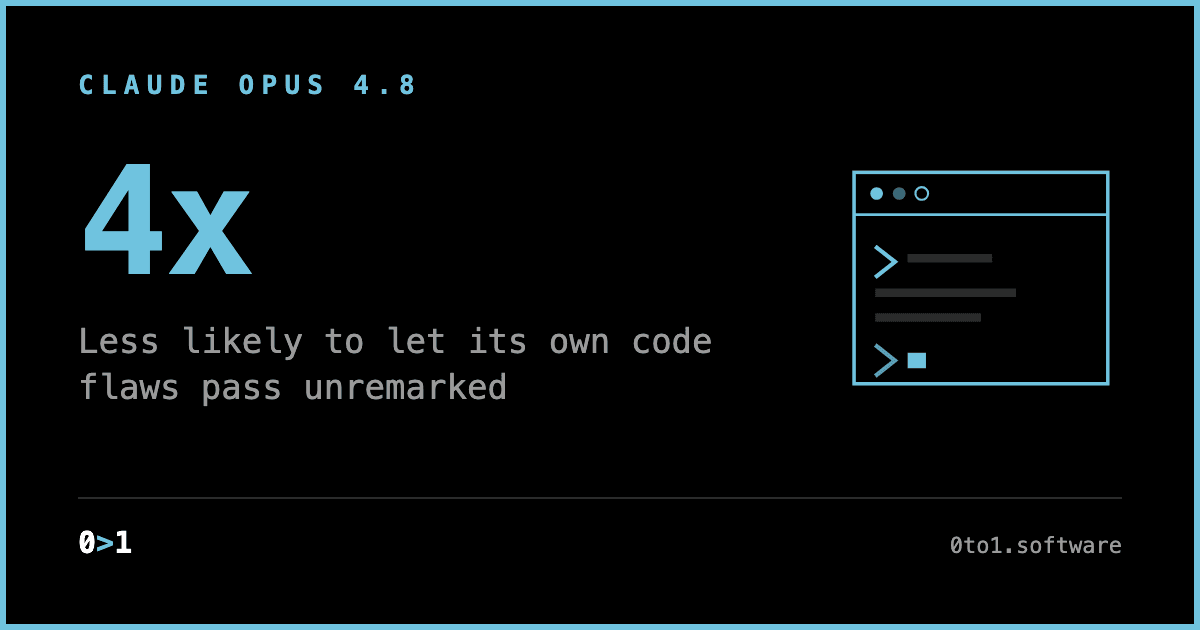
Anthropic reports that Opus 4.8 is around four times less likely than Opus 4.7 to let flaws in code it has written pass unremarked, and early testers describe a model that flags uncertainty instead of asserting progress. One evaluation team specifically called out its tendency to proactively flag issues with the inputs and outputs of an analysis, "something other models routinely missed and left to the users to catch."
If that holds up outside Anthropic's own evals, long-running agent loops become less expensive. Autonomous coding fails most expensively when an agent claims the migration is complete, the tests were adjusted rather than passed, and a human discovers the gap two days later. A model that says "I wrote this, but I'm not confident the error handling is right" is worth more than a model that scores two points higher on a benchmark and lies about its own output. The 4x figure is Anthropic grading its own homework, so run existing agent evals against claude-opus-4-8 and count self-flagged failures versus silent ones. This release makes a falsifiable claim about that property.
The alignment assessment reports rates of misaligned behavior substantially lower than Opus 4.7 and comparable to Claude Mythos Preview, which Anthropic describes as its best-aligned model. The full assessment is in the system card.
How effort control works and when to change it
Effort is now a user-visible control. On claude.ai and Cowork, a control next to the model selector sets how much effort Claude puts into a response, on all plans. Higher settings make the model think more frequently and more deeply; lower settings respond faster and burn rate limits more slowly.
Opus 4.8 defaults to high effort, and Anthropic says that on coding tasks this spends a similar number of tokens as Opus 4.7's default while performing better. The out-of-the-box experience is roughly cost-neutral against 4.7 with a quality gain. Above high sit "extra" (surfaced as xhigh in Claude Code) and "max," where the model spends more tokens to get better results. Anthropic recommends extra for difficult tasks and long-running asynchronous workflows, and rate limits in Claude Code have been raised to accommodate the higher levels.
Effort control changes routing: matching compute to task difficulty previously meant switching models, with different prompts, failure modes, and pricing tiers. A harness can now hold the model constant and vary spend per request. A CI-triggered lint fix and an overnight refactor can both run Opus 4.8 at different costs.
What dynamic workflows does in Claude Code
Dynamic workflows, shipping in research preview for Enterprise, Team, and Max plans, lets Claude plan the work, run hundreds of parallel subagents in a single session, then verify the outputs before reporting back. Anthropic's example is a codebase-scale migration across hundreds of thousands of lines, carried from kickoff to merge with the existing test suite as the bar.
The built-in verify step addresses a common problem in fan-out agent systems, which often produce plausible-looking work that nobody checked. "The existing test suite as its bar" states the limit: the migration is as good as your tests. A codebase with thin coverage will get a migration verified against thin coverage. Investment in the test suite is now investment in agent throughput because the suite is the specification the fleet of subagents converges on.
The announcement also notes that Opus 4.8's subagents can run for longer than before, which compounds with the parallelism as more agents have more runway.
The Messages API change harness builders should care about
The Messages API now accepts system entries inside the messages array. Developers can update Claude's instructions mid-task without breaking the prompt cache and without routing the update through a user turn. Anthropic names the intended uses: updating permissions, token budgets, or environment context while an agent runs.
Mid-task steering previously forced a choice between two options. Rewriting the system prompt invalidates the prompt cache, paying full input price on a context that might be hundreds of thousands of tokens. Injecting the update as a fake user message contaminates the conversation: models weight user turns differently from system instructions, and content arriving on the user channel is where prompt-injection defenses focus. A system channel inside the message stream lets permission changes, budget updates, and environment changes reach the model with the cache intact.
Pricing, including the fast mode cut
| Mode | Input / MTok | Output / MTok | Notes |
|---|---|---|---|
| Regular | $5 | $25 | Unchanged from Opus 4.7 |
| Fast mode | $10 | $50 | ~2.5x speed; 3x cheaper than fast mode on previous models |
Anthropic has kept the same price for Opus point upgrades, and fast mode now offers 2.5x speed at a 2x multiplier over base price, down from three times that premium. For latency-sensitive agent steps such as a quick verification pass or an interactive review loop, fast mode may be appropriate.
What Anthropic signaled about the roadmap
Anthropic says it is working on models that deliver much of Opus's capability at lower cost, and separately plans "a new class of model with even higher intelligence than Opus." Under Project Glasswing, a small number of organizations are using Claude Mythos Preview for cybersecurity work, gated behind stronger cyber safeguards that Anthropic says are progressing quickly, with general availability of Mythos-class models expected "in the coming weeks."
Opus 4.8 is a consolidation release. It is more reliable and more honest about its own work than its predecessor, and it's cheaper to run fast, while the tier above it is already in limited deployment. The migration is a one-line change to claude-opus-4-8 at unchanged prices. Workflows need to earn xhigh effort, and test suites need to be strong enough for a dynamic-workflows migration. Harnesses need to handle a system channel they can write to mid-task.
Sources
Related essays
- Why Claude Code Refuses Repos That Mention OpenClaw
How Claude Code ingests git history into the model's context, why a commit mentioning OpenClaw can trigger refusals or extra charges, and how to debug it.
- Claude Code Quality Issues: What Happened
Claude Code quality issues in April 2026 came from reasoning defaults, lost session context, and a prompt constraint. Learn the fixes.
- How to Detect Claude Code Quality Regressions in Your Logs
What a data-mined GitHub issue reveals about measuring Claude Code quality regressions from session logs, and why extended thinking depth matters.