// blog/gpt-5-6-sol-preview-models-benchmarks-gated-launch
GPT-5.6 Sol Preview: Models, Benchmarks, Gated Launch

On June 26, OpenAI announced a limited preview of the GPT-5.6 series: Sol, the flagship; Terra, a balanced model for everyday work; and Luna, the fast, low-cost tier. The capability claims are what you'd expect from a frontier release. The release process starts with a limited preview for a small group of trusted partners at the request of the U.S. government, with the partner list shared with the government, before general availability "in the coming weeks." The announcement describes both the model's capabilities and how frontier releases may work from now on.
What Sol, Terra, and Luna are
The GPT-5.6 series is a three-tier lineup, and OpenAI's own framing of each tier is worth keeping straight:
| Model | OpenAI's positioning |
|---|---|
| GPT-5.6 Sol | Flagship; "our strongest model yet" |
| GPT-5.6 Terra | Competitive performance with GPT-5.5 at 2x cheaper |
| GPT-5.6 Luna | Strong capability at OpenAI's lowest cost |
The preview has no actual prices. The Terra claim is relative (half the cost of GPT-5.5 at competitive performance), and no per-token numbers appear in the preview post. If the relative claim holds at GA, Terra is the practical headline for most teams. The tier that moves the price floor for "good enough" production performance is usually more consequential than a flagship launch, and a GPT-5.5-class model at half the cost would move that floor.
The preview also ships two new controls. There is a new "max" reasoning effort, which OpenAI describes as giving Sol the most time to reason deeply, and a new "ultra mode" that "goes beyond the capabilities of a single agent by leveraging subagents to accelerate complex work." Ultra mode gets one sentence in the announcement and raises more questions than it answers.
What the benchmark claims say
OpenAI shared a preview set of evaluations across three domains: agentic coding, biology, and cybersecurity. The specifics:
- Terminal-Bench 2.1: Sol sets a new state of the art on this benchmark, which tests command-line workflows requiring planning, iteration, and tool coordination.
- GeneBench v1: on long-horizon genomics and quantitative-biology analyses, Sol scores higher than GPT-5.5 while using fewer tokens.
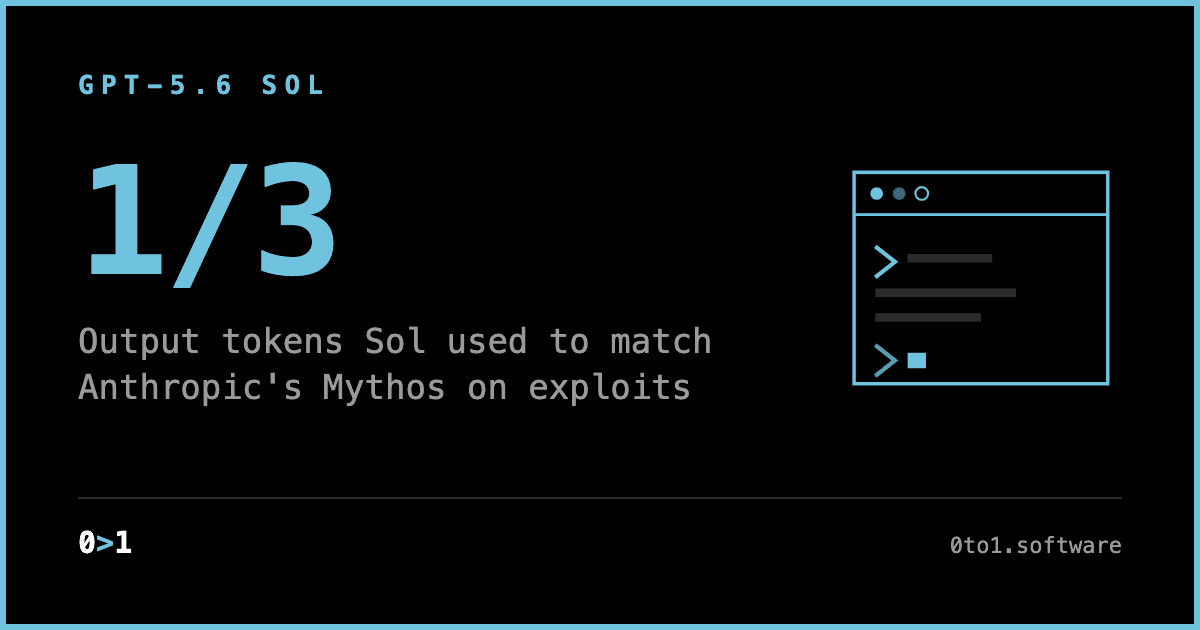
- ExploitBench: Sol is competitive with Anthropic's Mythos Preview while using roughly one third of the output tokens.
- ExploitGym: a benchmark built by UC Berkeley researchers in collaboration with OpenAI and other frontier labs; Sol, Terra, and Luna all show strong improvements in cyber capability as reasoning effort increases.
The preview post has no absolute numbers. OpenAI says an expanded suite of results comes with broad availability, and the system card carries the safety and preparedness evaluations. Until those land, "new state of the art" and "competitive with" are claims to file, not results to build on.
The recurring metric is tokens, not just scores. GeneBench results come with "fewer tokens." The ExploitBench comparison is explicitly a token-efficiency claim, matching a rival flagship at a third of the output. OpenAI describes Sol as shifting "the performance-efficiency frontier" on long-horizon security tasks. This targets people who run agents for hours, where a long-horizon task's cost scales with output tokens across the whole trajectory. Reaching the same answer in a third of the tokens would materially affect those workloads, and OpenAI now presents it as a headline stat rather than a footnote.
OpenAI benchmarked directly against Anthropic's Mythos Preview by name on an exploitation benchmark in a launch post. Labs comparing against each other's published flagships is normal; naming a competitor's preview-tier model as the bar on a cyber eval signals where OpenAI thinks the competitive frontier currently sits.
What ultra mode might mean for agent architecture
The ultra mode sentence is short: it "goes beyond the capabilities of a single agent by leveraging subagents to accelerate complex work." Practitioners have been building this pattern at the harness layer for a while now, fanning work out to subagents with isolated contexts and merging results. Frontier labs now offer it as a mode of the model itself.
When orchestration lives in your harness, you control decomposition, you see every subagent's transcript, and you can attribute cost per branch. Behind a provider's mode flag, the open questions become:
- How are subagent tokens billed and reported?
- Are subagent traces visible to the developer, or does ultra mode return a synthesized result?
- Does the developer influence decomposition, or is the fan-out fully model-driven?
- How does it interact with the new max reasoning effort, which is already a cost multiplier on its own?
The preview post does not answer these questions. Provider orchestration needs to leave developers able to observe and budget what it does.
Why the launch is government-gated
OpenAI previewed its launch plans and the models' capabilities to the U.S. government ahead of the announcement, as part of what it calls ongoing engagement. At the government's request, the release starts as a limited preview for a small group of trusted partners whose participation has been shared with the government. Broader availability follows after continued testing and coordination.
OpenAI's language about this arrangement is notably ambivalent. The post states: "We don't believe this kind of government access process should become the long-term default. It keeps the best tools from users, developers, enterprises, cyber defenders, and global partners who need them." The company describes the gate as a short-term step taken because it is "the strongest path to broader availability in the coming weeks," while it works with the Administration to develop the cyber Executive Order framework and, in its words, "a repeatable process for future model releases."
A frontier lab is publicly pacing a commercial release around a government review of cyber capability, objecting to the arrangement in the same breath, and helping design the framework that would formalize it. "Repeatable process" indicates that pre-release government coordination may become standard machinery for models above a certain cyber capability level. The next frontier release from any lab will show whether that template stuck.
The cyber safeguards, in OpenAI's own terms
The gating exists because of what the model can do in security work. OpenAI calls Sol its most capable model yet for cybersecurity, specifically on long-horizon tasks including vulnerability research and exploitation. The safeguard design goal is to make prohibited offensive activity "more difficult, uncertain, and detectable" while preserving legitimate work, which the post enumerates as code review, vulnerability research, patch development, debugging, security education, and defensive testing.
OpenAI says "GPT-5.6 Sol is better at helping people find and fix vulnerabilities than reliably carrying out end-to-end attacks." OpenAI says it spent multiple weeks finding weaknesses, pressure-testing the system, and hardening it against real-world attacks, and that the model does not cross the Cyber Critical threshold under its Preparedness Framework. The system card includes evaluations involving Chromium and Firefox.
OpenAI prioritizes providing cyber capability to people finding weaknesses and shipping patches. The asymmetry claim and the "meaningfully constraining prohibited offensive use" assessment are OpenAI's evaluation of its own safeguards, published during a preview only trusted partners can touch. Independent pressure on those safeguards starts when broader access does.
What to check when GA lands
The preview post is claims plus a process; general availability is where it becomes checkable. The short list:
- Terra's actual pricing. The 2x-cheaper-than-GPT-5.5 claim has the widest effect on production workloads.
- Absolute benchmark numbers. Terminal-Bench 2.1, GeneBench v1, and the ExploitBench token-efficiency comparison all need published figures behind them.
- Ultra mode mechanics. Billing, trace visibility, and developer control over subagent fan-out determine whether it fits real agent systems or stays a demo feature.
- Whether the gate repeats. If the next capable model from OpenAI or anyone else opens with the same trusted-partner preview, the cyber Executive Order framework has become the release process.
Once the API opens, users can evaluate the model line. Pre-release government coordination may still shape frontier releases a year from now.
Sources
Related essays
- OpenAI Classified Network Deal: What Was Agreed
What OpenAI's Department of War agreement covers: classified network deployment, cloud-only hosting, forward-deployed engineers, safety terms.
- OpenAI Jalapeño Chip: Specs, Benchmarks, Roadmap
OpenAI Jalapeño chip specs and benchmarks: 216 GB HBM4, 13.4 PFLOPS at 700W, and a claimed 1.5-1.9x performance-per-watt lead over Nvidia GB300 systems.
- How Many Tokens Does Claude Code Send Per Request?
Proxy-level measurements of Claude Code token overhead: the 33k request floor, cache write behavior, instruction file cost, and subagent fan-out.